The Code Was Never the Goal

Conventional wisdom is that AI coding raises the floor — that it allows mediocre engineers and even non-coders to be more productive. To some degree this is true, but when it comes to serious engineering projects it’s largely backwards. AI is making bad engineering expensive for the first time.

I’m a consultant. I dive into codebases I’ve never seen and get productive faster than the developers who’ve worked on them for years. When people ask how, the honest answer isn’t “I read faster” or “I ask good questions.” It’s that I apply working knowledge of how systems behave before reading the specific code. I can infer a lot of structural things, behaviors and potential bugs from seemingly superficial details — because there are rules that govern all systems. Doing something over the network or async? Somewhere there should be a timeout, and most likely it’s ill-defined. Using timestamps? I already know what time-related bugs to look for, because developers always make wrong assumptions about time. This isn’t magic — it’s years of experience and theoretical knowledge about systems, hardware, and physics that amalgamated into intuition.
Pop Software and the Johnnie Walker Problem

Johnnie Walker Black Label has a reputation for quality. It’s served at business dinners, gifted to clients, stocked by hotels that want to signal sophistication. The brand carries decades of accumulated prestige.

It’s also not particularly good whisky.

That’s not a bug — it’s the business model. Reputation is a lagging indicator. It reflects what a thing was, not what it is. As long as most consumers can’t tell the difference, the gap between signal and substance is exploitable indefinitely. Luxury goods entire market structure is built on this: the product is the brand. The contents are secondary.

These are your father's dotfiles

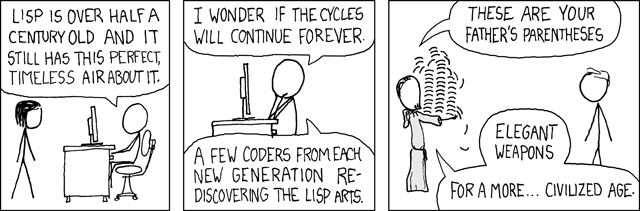
These are your father’s parentheses

This famous XKCD keeps popping into my mind as I watch Claude Code insisting on running stuff like find . -name "*.py" | xargs grep "function_name" across a fifty-thousand-line codebase, burning tokens like mad, waiting, waiting — when ctags could have answered in milliseconds. The crazy thing isn’t that Claude is doing it, it’s that people are watching the madness and approve mindlessly… as if a better way wasn’t the standard just a short while ago.

The Valuation Function Problem: Why Skin in the Game Fails When It Matters Most

As tensions between Iran, Israel, and the United States escalate, a familiar argument resurfaces in op-eds and think-tank threads: if only the decision-makers had real skin in the game — if generals’ sons were drafted, if politicians stood in the line of fire — they’d be far less eager for war.

It’s an appealing theory. It’s also built on an assumption so large, and so rarely examined, that accepting it uncritically will lead you to make systematic forecasting errors about some of the most dangerous situations in the world.

The Ego and the Exo-Ego

An exoskeleton is a mechanical frame you wear that amplifies your physical strength. Strap one on and suddenly you can lift hundreds of kilos, work for hours without fatigue, accomplish physical feats impossible for an unaided human body. The military loves them. So do factories and logistics companies.

But there’s a catch: use an exoskeleton long enough and your muscles atrophy. Your body adapts to the assistance, grows dependent on it. Take the exoskeleton off and you’re weaker than when you started. The amplification comes with a hidden cost - you’ve outsourced your strength to a machine, and your natural capacity degrades from disuse.

The Model Habituation Problem

Economists love to talk about government deficit spending as “borrowing money from the future.” It’s a neat mental model that helps explain fiscal policy: we take on debt today to fund infrastructure, social programs, or whatever, and future taxpayers will pay it back. The model implies a simple trade-off between present and future consumption, mediated by interest rates and growth projections.

There’s just one problem: you can’t actually borrow steel from the future.

No Judgment

A long time ago I worked for a Porn company. As someone who grew up orthodox Jew and turned secular later in life, I had to consciously reorient my moral compass regularly; When a recruiter for that company contacted me I suspended my knee jerked “no” reaction and asked myself “why?” - it’s not like I hadn’t watched porn occasionally (I later learned to avoid it, it’s basically sexual junk food), so what’s my problem supporting its creation? And if I do have a problem with it, where do I draw the line? participating in a movie was an obvious “no”, but would I work for a company that had Porn companies as clients? pragmatically and morally it was an obvious “yes” for me - somewhere between these were my boundaries. When you do these kind of mind exercises, it soon becomes clear that practical applied morality (as opposed to abstract ideological morality) is very fluid. I ended up realizing I don’t view porn as morally problematic but rather as aesthetically problematic, so as long as my particular job was interesting and didn’t involve watching too much junk I was ok with it.

The Marshmallow Effect

Campfire roasted Marshmallow is a childhood classic. Everybody knows what Marshmallow tastes like… Or do they? Because, as it turns out, Marshmallow doesn’t contain any Marshmallow!

Marshmallow confection was originally made from Marshmallow root (hence the name) but as food industry was moving to mass production the original recipe was changed to utilize widely available and cheap materials such as corn starch and gelatin; Marshmallow root was expensive and not available outside of Europe nor in large quantities. All that was left of Marshmallow root in the recipe was the name, and after so long no one even remembers that Marshmallow is actually plant with a unique flavor.

Don't Paint the Roses

In one scene of the classic “Alice in Wonderland” movie, Alice encountered cards painting rose bushes.

The fact is, miss: we planted the white roses by mistake. And, the queen, she likes them red. If she saw what we did, she’d raise a fuss and each of us would quickly lose his head.

Unfortunately for the cards, the queen notices the paint and beheads them anyway.

No is Positive

“No” is one of the most important yet underused word in our languages. It’s importance cannot be overstated, yet in our culture saying “no” is often considered a negative. Saying “no” is frowned upon, sometimes considered rude, unfriendly or even aggressive - and when you say “no” people get angry. As a result, some people are terrified of saying “no” and their inability to say “no” makes them a danger to themselves and everyone around them. This may sound outrageous to someone who is conditioned to thing that “yes” is helpful, cooperative and positive and “no” is unhelpful, uncooperative and negative; However, like so many things people take for granted once you give this some deep thought it becomes very obvious that “common sense” just isn’t.